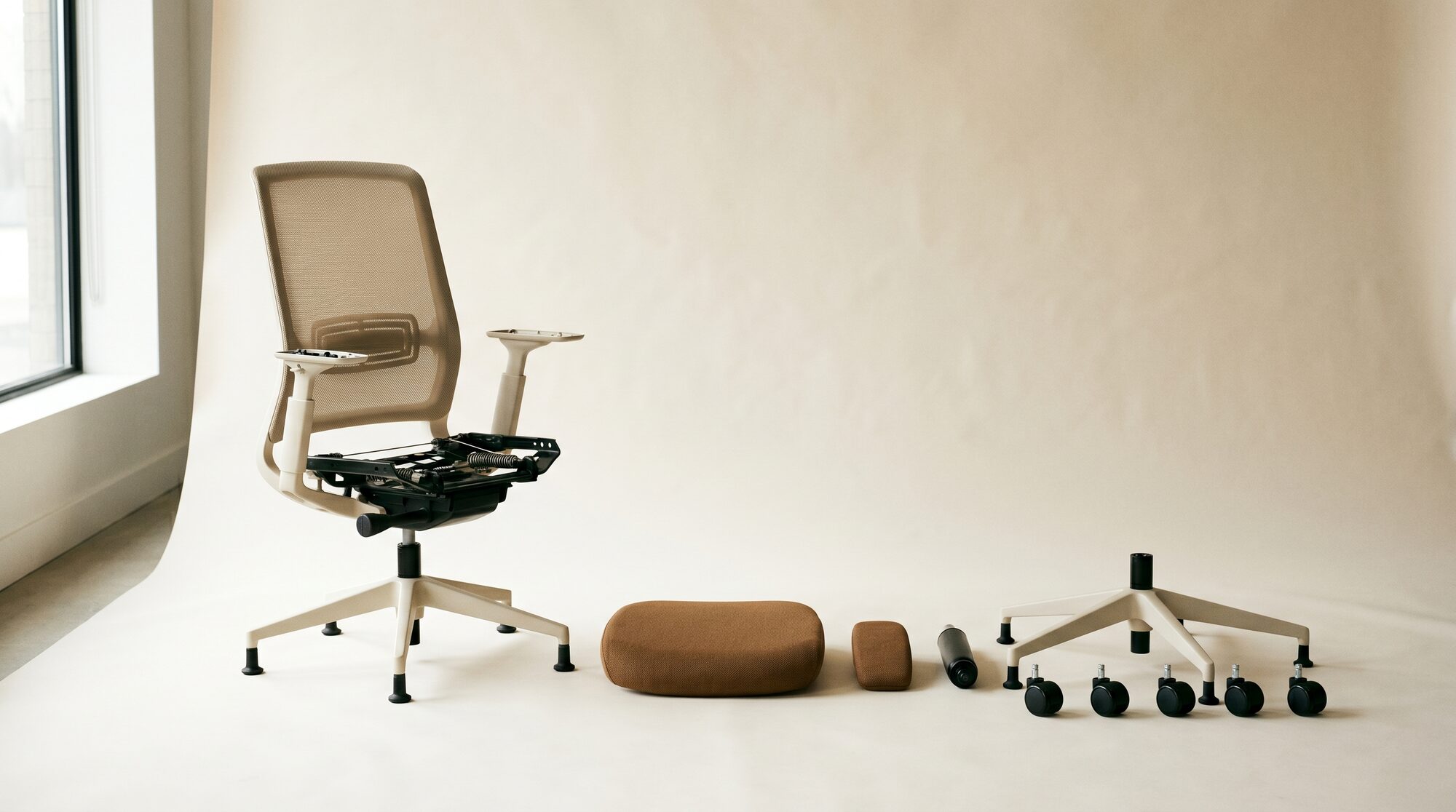
The fastest way to waste money on an office is to buy furniture that can’t be fixed. A chair with a worn seat pad gets thrown out. A desk with a failed motor becomes scrap. A sofa with a stained cushion lives in a storage room until someone pays to haul it away. None of that has to happen.
Evergreen furniture lines — products kept in production for a decade or more, with parts that can be ordered individually — are the single biggest lever a facilities manager has against waste, downtime, and creeping replacement costs. They’re also, quietly, one of the main things we look for when we curate a partner brand.
What “evergreen” actually means
An evergreen line is a product the manufacturer commits to keeping alive. Same model name, same fabric options, same component dimensions, year after year. If you buy 80 task chairs today and need 20 more in 2029, you get 20 more of the exact same chair — not a “successor” that looks close but doesn’t match.
That continuity is the foundation everything else is built on. Replaceable parts only work if the part number you need in year seven still exists.
The waste problem
Commercial furniture is one of the largest categories of landfill waste in North America. The EPA estimates millions of tonnes of office furniture are discarded each year, and the majority of it is thrown out not because it’s broken, but because a single component has failed and there’s no economical way to repair it.
A task chair is a perfect example. Most of the mass — the frame, the base, the mechanism — will outlast two or three generations of the parts that actually wear out: the seat foam, the armrest pads, the gas cylinder, the casters. A chair built around replaceable components lasts fifteen years. A chair built as one monolithic unit lasts three.
“The greenest chair is the one you already own, for the fifteenth year in a row.”
Why facilities teams love them
Sustainability is the headline. The reason FMs fight for evergreen lines internally is operational.
- Predictable repairs. One broken caster means one caster — ordered, installed in five minutes, chair back on the floor the same day.
- Matched expansions. Hiring ten more people doesn’t mean re-procuring a whole zone. The new desks look identical to the ones from two years ago.
- Lower total cost of ownership. A $200 cylinder replacement is a lot cheaper than a $900 new chair — and it doesn’t require a PO for capex.
- No aesthetic drift. Offices that replace furniture piecemeal across mismatched generations start to look tired fast. A consistent line ages gracefully.
- Serviceable by your own team. Most part swaps don’t need a technician. A maintenance lead with a hex key can handle 90% of the failures a chair will ever see.
How to spot one
Not every catalogue page tells you whether a product is genuinely evergreen. A few questions cut through the marketing:
- How long has this exact model been in production? Anything under five years is a bet, not a commitment.
- Can I order individual parts — casters, cylinders, arm pads, fabric panels — ten years from now? Get it in writing.
- Are replacement fabrics dye-matched to the current stock, or will a recovered seat look subtly off?
- Is the warranty structured around part replacement, or does it quietly push you toward whole-unit swaps?
- Does the manufacturer publish an exploded parts diagram? If a service tech can’t find the screw, neither can your team.
The test we use internally: if a specific chair is discontinued by the time a client calls us about a worn armrest, we shouldn’t have recommended it in the first place.
The trade-off nobody talks about
Evergreen lines don’t chase trends. That’s the point, and it’s also the hardest part of the sell. If your design director wants the chair that was on the cover of a magazine last month, an evergreen classic isn’t going to win that argument.
The compromise we usually land on with clients: evergreen for the long-haul workhorses — task chairs, desks, storage, meeting room seating — and statement pieces for lounges, reception, and any area where the aesthetic is doing real work. You get longevity where it matters and personality where it’s visible.
What we stock for a reason
Every brand in our partner portfolio meets a minimum bar on parts availability. It’s the first question we ask a new manufacturer, and it’s the reason some well-known names aren’t on our list. If we can’t tell a facilities manager what to do when a part fails in year eight, we don’t carry the line.
That’s not a green marketing position. It’s the honest way to sell something a client is going to live with every day for the next decade.